
Citizenship and Government & Politics
Welcome to Citizenship and Politics!
Citizenship and Politics give young people the opportunity to learn about how their society works and to develop the knowledge, skills and attitudes needed to play a positive role in their communities. We believe it is of the utmost importance that young people learn how to work co-operatively to address issues of common concern and to develop the skills needed to participate effectively in public life. Only by understanding their duties, responsibilities and rights as citizens will young people grow up with a sense of agency and belief they can use the democratic process to improve society.
Citizenship and Politics offer young people a framework with which to make sense of the opportunities and risks of their rapidly changing world. Our vision as a department is to nurture informed and active citizens who have the confidence and conviction to engage with the decision-making process and exert influence in an informed and constructive fashion.
Citizenship and Politics are dynamic and contemporary subjects which investigate and debate topical issues and events. They are subjects of debate and disagreement, and of rival viewpoints and competing opinions. Pupils are not taught what to think but how to think. Studying Citizenship and Politics will nurture a capacity for critical thinking and also develop a number of key skills such as analysis and evaluation, research and information gathering, and the ability to construct reasoned and coherent arguments.
Our Citizenship and Government & Politics Curriculum Map:
(Citizenship and Government & Politics Curriculum Map 2026-2027 Link)
Our curriculum
At Key Stage 3 students study Citizenship for one hour a week in Years 7 & 8, and then for one hour a fortnight in Year 9. Pupils study units on democracy and political literacy, rights and responsibilities, justice and the legal system, and international relations. The curriculum is tailored to explore key concepts through issues that young people can identify with. For example, students investigate the use of child soldiers, debate the issue of smacking and examine racism by looking at sporting case studies.
Year 7
Year 8
Year 9
At Key Stage 4 Citizenship is an optional GCSE subject. Units on rights and the legal system, democracy and government, and the UK and the wider world are studied. Pupils will also undertake a project to bring about positive change in their communities using the democratic process. The course will appeal to pupils who want a better understanding of the world around them and how their society works. It will also appeal to those who have an interest in current affairs and who enjoy investigating and debating contemporary issues.
Year 10
Year 11
At Key Stage 5 students can choose to study A Level Politics. The course explores the political concepts central to an understanding of the modern world. Politics is essentially the study of power- who gets what, where and when? The course will develop an in-depth knowledge of the UK political system and the sources of power within it. Pupils also study a number of key political ideologies such as Conservatism, Liberalism and Socialism. Students will also examine the US political system in order to undertake a comparative analysis with the UK.
Year 12
Year 13
Enrichment and extra-curricular activities
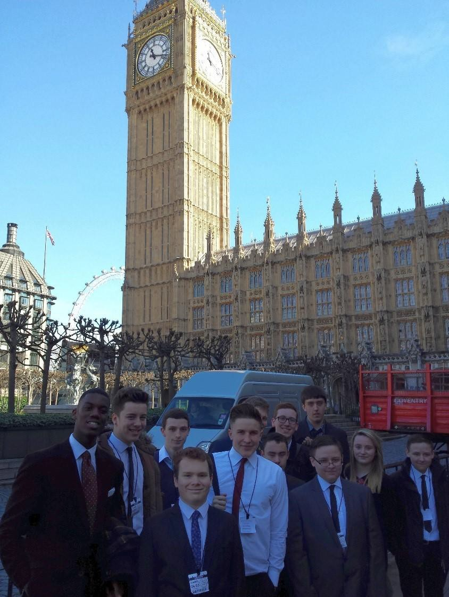
At GCSE and A level pupils get the chance to visit Parliament and meet with their local MP, and also visit the Supreme Court. There is also a debate club where students get the opportunity to discuss and debate contemporary issues.
Destinations
Every year a number of students go on to study Politics or International Relations at undergraduate level with some studying at top universities such as LSE. Other popular degree choices for A level Politics students include law, economics, sociology and history.
Subject Leader: Ben Howard - bhoward@carshaltonboys.org